In this episode, we're talking about PMI. PMI stands for Private Mortgage Insurance. PMI, or Private Mortgage Insurance, is associated with conventional loans. This insurance protects lenders when the loan is private and non-governmental.
Take Control of Your Mortgage Costs
Wondering how much PMI will impact your monthly payments? Let us help you break down the numbers and explore your options to save more. Reach out today for personalized guidance.
Get Your PMI EstimateWhen is PMI (Mortgage Insurance required?
PMI is required for loans with less than a 20% down payment.
How is PMI Calculated?
PMI rates depend on several factors:
- Down payment percentage (e.g., 5%, 10%, 15%)
- Loan amount
- Number of borrowers
- Credit score
- Property type
- Debt-to-income ratio
PMI on Investment Properties
Technically for Investment properties the minimum down payment is 15%, and in these cases if a borrower puts down only 20% they will have PMI. The issue is, the PMI is extremely expensive and the interest rate could be higher. As a result most investment borrowers put a minimum of 20% down to avoid the extra cost.
An example quote for Private Mortgage Insurance
Check out this PMI example quote. This is from the private mortgage insurance company, Radian.
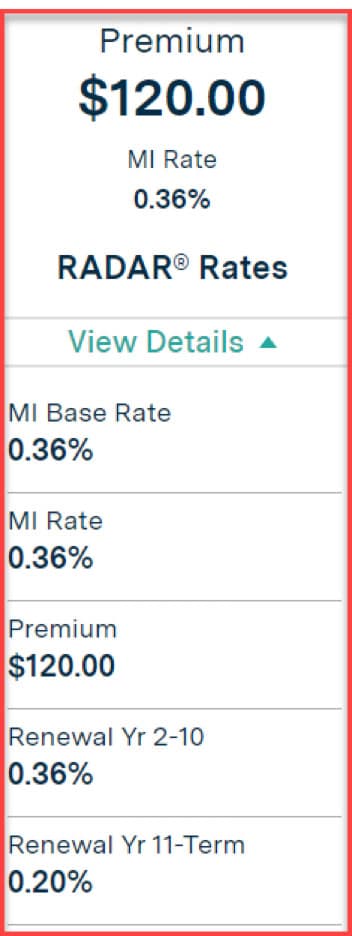
When calculating this rate, we put in a 5% down loan, a $200,000 loan amount, one borrower, a 760 credit score, single family residence, and we selected it to be a primary residence. For a $400,000 loan with a 5% down payment, one borrower with a 760 credit score, and a primary residence, the PMI is about $120 per month at a rate of 0.36% (annually divided by 12). This rate may adjust after 10 years, potentially decreasing to 0.2%, though many refinance before reaching this period.
Deepen your mortgage knowledge by exploring our explanation of payment timing, the fundamentals of amortization, and insights on trigger leads. You might also be interested in our overview of APR basics and a closer look at closing costs along with mortgage payoff issues.
How to remove PMI Mortgage Insurance?
Your monthly PMI payment decreases as your loan amount reduces, although the PMI rate remains constant. There are 2 ways you can have Mortgage Insurance removed;
- By law, PMI must be removed when the loan amount reaches 78% of the original value. This should happen automatically, whether you make your scheduled payments or whether you decide to accelerate your principal reductions.
- If you have been making online mortgage payments for at least 12 months and you believe your home equity is greater than 20%, you can contact your mortgage lender and petition the mortgage lender to have it removed. The mortgage lender is not obligated to remove it in this case, but often, they will consider removing it. They often will order an appraisal to verify the value and the amount of equity you have in the home. After considering your payment history and equity, they may remove the Mortgage Insurance.
•••
Be sure to ask us for a free quote on your next mortgage. We'll personally work with you and help you through the whole process.
Mortgage Brothers LLC does not provide tax, legal, or accounting advice. This material has been prepared for informational purposes only. You should consult your own tax, legal, and accounting advisors before engaging in any transaction. Mortgage Brothers NMLS 1007154, NMLS #210917 and 1618695. Equal Housing Opportunity.
Transcript of the Mortgage Brothers Podcast
Eddie Knoell: I'm Eddie Knoell.
Tom Knoell: And I'm Tom Knoell. Welcome, everyone! This is the Mortgage Brothers Podcast Show. Today, we're talking about PMI: Private Mortgage Insurance.
What Is PMI? [00:02]
Eddie: What is this mortgage insurance, and how do we calculate it?
Tom: PMI stands for Private Mortgage Insurance. You'll hear it often if you're dealing with conventional loans, specifically Fannie Mae and Freddie Mac loans.
Eddie: PMI applies to loans with less than a 20% down payment. If you have more than 20% down, you don't need PMI.
Tom: A quick note: PMI is not government insurance. It's used for conventional loans. For FHA loans, the insurance is government-backed.
Factors That Determine PMI [01:40]
Eddie: So, how is PMI calculated? Six main factors determine the cost of PMI:
- Down Payment Percentage: Calculated in 5% increments (e.g., 5%, 10%, 15%).
- Loan Amount: Larger loan amounts typically mean higher PMI.
- Number of Borrowers: Two borrowers reduce risk slightly, leading to a lower PMI rate.
- Credit Score: A higher score (760+) secures the best rates, while scores below 760 are graded in 20-point increments.
- Property Type: Single-family homes typically have lower PMI rates than condos or townhomes.
- Occupancy Type: PMI is lower for primary residences compared to second homes or investment properties.
Tom: Oh, and don't forget the Debt-to-Income (DTI) Ratio. A DTI over 45% may result in additional fees.
Example Calculation of PMI [03:19]
Eddie: Let's break down an example:
- Loan Amount: $200,000
- Down Payment: 5%
- Credit Score: 760+
- Borrowers: One
- Property Type: Single-family residence
- Occupancy: Primary residence
The PMI rate is 0.36% annually. To calculate the monthly PMI:
PMI = Loan Amount × PMI Rate ÷ 12
For example, for a $200,000 loan:
PMI = 200,000 × 0.0036 ÷ 12 = $60/month
Does PMI Change Over Time? [05:13]
Tom: PMI is static for the first 10 years. After year 10, it adjusts downward. For example, a PMI rate of 0.36% might drop to 0.20% in year 11.
Eddie: However, most people refinance or sell their homes before they reach year 10. So, this reduction often doesn't come into play.
When Is PMI Removed? [06:09]
Tom: PMI is legally required to be removed when the loan balance reaches 78% of the original value. This typically happens around year 12.
High DTI Ratios [07:19]
Eddie: Be cautious with high debt-to-income ratios. A DTI over 45% might increase PMI costs because lenders see it as higher risk.
Tom: Lower DTI ratios can help keep PMI rates down, so managing debt is key.
Final Thoughts [07:52]
Eddie: That's the nuts and bolts of PMI!
Tom: There's a lot more to cover, but this gives you a solid foundation.
Eddie: Thanks for listening, and let us know if you have any questions. Feel free to reach out for a personalized quote on your next mortgage.
Contact Information
Contact: Contact Form
NMLS: 1007154
Disclaimer: This material is for informational purposes only. Consult your tax, legal, and accounting advisors before any transaction.